4th Grade Review of Types of Triangles Quadrilaterals Worksheet
Geometry
The field of geometry is broad and has many applications. Often, problems of other field become easier to solve when it is represented geometrically. The study of geometric relationships is used in the field of architecture and landscaping. It is seen that the many people recollect ameliorate visually. Geometry makes visualization logical.
The kids are introduced to geometry math during early school years. The geometry common cadre math standards involve an introduction to geometry in prekindergarten. Discovering geometry helps children develop deductive problem-solving skills.
Many researches take shown that children learn better through games. In contempo times, math games have become popular. Ane of the near important reasons to innovate learning games in Mathematical teachings is the excitement and enthusiasm it brings in to the kids. Math games enable children to experience success and satisfaction and thereby, develop confidence in their newly acquired skills. Mathematical field of geometry requires visualization for better agreement.
Progress of Geometry with grades
Related below-grade standard

Form three:The kids empathise the relationship between shapes according to their attributes. They learn about the larger category shapes with shared attributes. For example, the shapes with iv sides are called quadrilaterals. They partition shapes into equal parts. They learn to limited the area of each office as a unit fraction of the whole. For example, they partition a shape into ii equal parts and describe the expanse of each part as 1/2 of the area of the whole.
Form 4: The kids learn nigh points, line segments, lines, rays and types of angles. The kids identify these in two-dimensional figures. They also learn about parallel and perpendicular lines. They classify the figures on the basis of the parallel or perpendicular lines. They as well classify the figures according to the angles of specified size. As well, they acquire near the dissimilar types of triangles in geometry. The kids also learn nigh line of symmetry for a two-dimensional figure. They draw lines of symmetry and identify line-symmetric figures. By the end of grade 4, the kids develop a deep understanding of what is geometry. 
Related above-course standard

Grade 5:The kids are introduced to coordinate geometry. They learn to graph points on a coordinate system consisting of perpendicular number lines called axes. They represent mathematical problems past graphing points on the geometry airplane. They besides acquire to classify unproblematic geometry figures into categories and sub-categories on the footing of the geometric properties. For example, all squares and rectangles are quadrilaterals. All squares are rectangles. They learn to classify ii-dimensional shapes in a bureaucracy.
Identifying lines and angles and classifying shapes by backdrop of lines and angles
- Identifying line, line segments, and rays: In course 4, the kids are introduced to geometric objects like line, line segments, and rays. They learn to define geometry lines, line segments, and rays. They also sympathize the relationship between them. For example, they acquire that a ray has one end point and a line segment has 2 end points. They learn to place these in 2-dimensional figures.

The kids notice it easier to empathize line segments equally they encounter examples of it in daily life. However, they find the concept of ray and line in geometry niggling abstract. They as well learn geometry symbols for naming geometric line and ray in geometry.
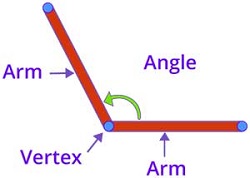
- Understanding Angles: In class four, the kids are introduced to geometry angles. They sympathize the definition of angle. They sympathise angles as a effigy formed by 2 rays sharing a common end signal. They understand that ii rays are called the arms of the angles and the common endpoint is called the vertex of the angle. They build on their agreement of square angles learned in class three. They identify square angles as right angles. They learn about the acute and obtuse bending. They use correct angles to compare whether the angle is equal, greater than or less than right angles. Solving several angles worksheet enable them to gain fluency in the identification of different types of angles.
- Identifying Parallel and Perpendicular lines: The kids build on their understanding of parallel lines learned in course 3. They learn geometry definitions of parallel and perpendicular lines. They empathize parallel lines every bit the lines that are e'er equidistant no affair how far they are extended. The kids sympathise perpendicular lines every bit the lines that intersect at right angles. The kids identify these lines in two-dimensional figures. They allocate the shapes on the basis of absence or presence of parallel and perpendicular lines. For case, they identify square and rectangles as shapes that have two pairs of parallel and perpendicular lines each.

- Agreement Triangles: In grade 4, the kids develop a deeper agreement of the triangle geometry. They become a geometry review of triangles. They learn to allocate triangles equally equilateral, isosceles, and scalene. They sympathise that triangle whose all angles or all sides are equal is called an equilateral triangle. A triangle whose exactly two angles or two sides are equal is called an isosceles triangle. A triangle whose no 2 sides or angles are equal is called scalene triangle.
- Identifying Parallel and Perpendicular lines: The kids build on their understanding of parallel lines learned in course 3. They learn geometry definitions of parallel and perpendicular lines. They empathize parallel lines every bit the lines that are e'er equidistant no affair how far they are extended. The kids sympathise perpendicular lines every bit the lines that intersect at right angles. The kids identify these lines in two-dimensional figures. They allocate the shapes on the basis of absence or presence of parallel and perpendicular lines. For case, they identify square and rectangles as shapes that have two pairs of parallel and perpendicular lines each.
They also learn to allocate geometry triangles every bit acute, correct and obtuse triangles. A triangle in which all angles are equal is called acute triangle. A triangle in which one angle is right angle is called right triangle. A triangle in which i bending is obtuse angle is called obtuse triangle. They also learn to cross-allocate triangles as a right isosceles triangle. At this stage, the kids are suggested to brand a geometry reference sheet including detailed classification of quadrilaterals and triangles.
- Understanding Line symmetry:
The kids recognize lines of symmetry for two-dimensional figures. They place line-symmetric figures. They learn to draw lines of symmetry. The concept of line symmetry is unremarkably taught through a sheet of paper. The sheet of paper is folded into one-half and is cutting into different shapes. When the canvass is unfolded, the kids see the mirror shape of the shape being cut. For example, to cutting out a heart shape, the sheet is folded into half and a shape like this is cut. When the canvass in unfolded, a heart is formed

Then, the kids understand that centre it is a line symmetric shape. For a clearer understanding, the kids need to have feel with symmetric and not-symmetric shapes. The kids also develop an understanding that a effigy can have more than than ane line of symmetry. For example, a square has three lines of symmetry.
Geometric Measurement
- Understanding Angles measurement: The kids understand the connection betwixt angles and round motion. An angle is formed by 2 rays known every bit arms of the bending. The common endpoint of the rays is known as the vertex of the angle. The angles are measured past considering circle as a reference. The vertex of the angle is taken to be the heart of the circumvolve. The arms of the bending are extended to intersect the circle. The angle is measured by considering the fraction of circular arc captured between the artillery of the angle. For instance, if the artillery of the vertex capture 1/360 of a circle, the angle are called one-degree bending.
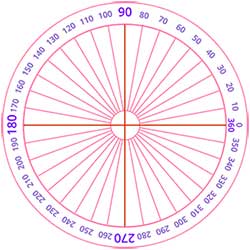
The kids understand that complete angle or full rotation around the circumvolve is 360°. They learn that birdbrained angle measures more than than xc° but less than 180°. The acute angle measure out more than 0° and less than 90°. The right angle measures 90°.
They too develop an understanding of complementary and supplementary angles. They understand 2 angles are complementary if they sum to 90°. 2 angles are supplementary angles if they sum to 180°. They also learn most next angles, straight angles, reflex angles, and complete angles. The kids practice angle relationships worksheet to become a deeper understanding of different type of geometric angles.

The kids learn to measure the angle using a protractor. Measuring angles using protractor requires lots of practice. The kids exercise lots of measuring angles worksheet to get fluent in their newly acquired skills.
- Decomposing angles: The kids recognize angle measure as additive. They understand that an angle can be decomposed into non-overlapping smaller angles. The kids employ their addition and subtraction skills to discover unknown angles. For instance, in the effigy on the correct, the whole bending measures 65° and the smaller bending measures twenty°. Subtracting the smaller angle from the whole angle will give the measure of the missing angle. Therefore, x° = 65° - 20° = 45°.

Class 4 Geometry: Foundation of Higher Geometrical Concepts
Grade 4 geometry forms the base of many high school geometrical concepts. It is of import that the kids perform ample geometry practice before they enter the next grade. The kids can refer a geometry common core book or tin can search online geometry textbook. They can even download geometry textbook pdf from the internet. There are many geometry solver websites that provide geometry mutual cadre answers or geometry workbook answers. One can only blazon in geometry textbook answers or geometry book answers in the search engine to detect answers to their geometry textbook online.
The geometry practice can be made fun by solving geometry crossword puzzle or by playing geometry word search. The geometric games and geometry projects act as a geometry tutor. The kids can clarify lots of misconceptions through geometric games. A comprehensive geometry exercise test based on the noesis acquired till form 4 prepares kids to perform well in geometry final exam and sympathise college geometry.
Source: https://www.splashlearn.com/geometry-games-for-4th-graders
0 Response to "4th Grade Review of Types of Triangles Quadrilaterals Worksheet"
Post a Comment