Review of Af P Nikkor 70 300mm F 45 56 Vr
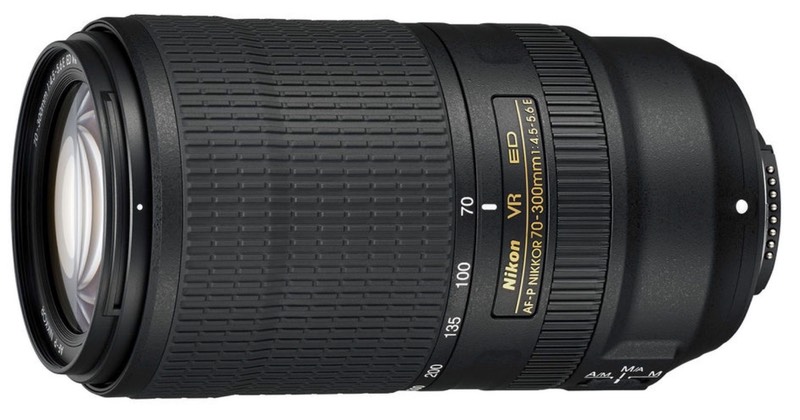
What is It?
Nikon sometimes gets themselves into incredibly hard to explain positions. The 70-300mm logjam at the moment is one of them. Incredibly, you'll find five different 70-300mm zooms in Nikon'south "current lens lineup."
So before we get to today'south lens, we need to do some 'splainin'.
Consumer telephoto zooms are popular lenses. Nikon's first lens in this range was the 75-300mm f/4.5-v.6 style back in 1989. Then came the long-lived 70-300mm f/4-5.6D from nearly 1998 to 2006. In 2006 Nikon introduced the 70-300mm f/4.v-5.6G VR, which is still available and was the main consumer telephoto Nikon sold through much of the DSLR growth spurt. All told, the lxx-300mm of various sorts has probably sold in the seven effigy numbers in terms of units.
But that G VR version of the lens started looking onetime and a bit underwhelming with the 24mp DX and 36mp FX bodies. It really needed a refresh, and it got 2 (three if you count VR versus non-VR versions). First we received the AF-P DX version. Now we've gotten an AF-P FX version.
Don't go dislocated by the similarities in specs. These are different lenses. Very different. The DX version has a very consumer build quality and is 10 ounces (265g) lighter. The optical pattern is simpler in the DX version and the net consequence is a slightly smaller and less expensive lens.
That said, many of the main specs, such every bit minimum focus altitude and maximum magnification ratio are nearly identical between the DX version and the new AF-P FX version.
Why was an FX version needed? Well, optically Nikon was pushing the boundaries on the DX version in terms of the imaging circle. A wider image circle was needed for FX. Only I think more to the point is that Nikon sees DX users different than FX users. And then piffling things practise come into play, like virtually no transmission focus ring, a 7-blade aperture diaphragm, the smaller f/6.3 aperture at 300mm, and more subtle things that new users probably wouldn't find on the DX version.
This 70-300mm f/iv.5-5.6E ED VR AF-P version of the lens that I'grand reviewing here is the latest FX version, and it just brings a more prosumer sense to most of the design and build elements than the DX version did. And yes, optically, it performs a bit differently.
Okay, let's get to the specifics of the lens nether review.
The new AF-P lenses use a very dissimilar arroyo to focus motors. The AF-P lenses take stepper motors in them that are unlike the previous AF-Due south lens motors, which use a piezoelectric or ultrasonic moving ridge motor. The good news is that these new stepper motors are fast and quiet. The bad news is that just a few cameras are uniform with them.
Nikon has been doing some firmware updating to brand more cameras compatible. To encounter the full list of what is and isn't compatible, run across Agreement the AF-P Lenses.
The 70-300mm f/iv.five-6.three AF-P VR DX was a flake of a surprise when introduced in Baronial 2016. The 70-300mm f/4.v-5.half dozen AF-P VR FX version much less so (though the AF-P bit was a surprise to many). That's considering the older 70-300mm FX lens was showing its age on most of the newer DSLRs, particularly those with high pixel density (e.chiliad. twenty/24mp DX, 36/45mp FX). Most of the Nikon community was expecting Nikon to simply update the full frame (FX) 70-300mm lens, not introduce a new DX-only version as well as an FX version.
And then, to exist clear, here are the five 70-300mm lenses Nikon currently sells:
- 70-300mm f/four.5-5.6G VR (The states$500) covers DX/FX (model 2161)
- 70-300mm f/4.5-5.6G (US$173) covers DX/FX (model 1928)
- lxx-300mm f/4.v-six.3G AF-P (US$350) covers DX (model 20061)
- 70-300mm f/four.5-6.3G AF-P VR (US$400) covers DX (model 20062)
- lxx-300mm f/iv.5-5.6E AF-P VR (United states$750) covers DX/FX (model 20068)
I don't usually put ownership recommendations in the first part of my reviews, just the complication Nikon has introduced here has forced me to deal with that:
- Do non purchase #two or #3. No VR in a telephoto lens that you might handhold is a error. Plus #2 is seriously not capable of handling the pixel count of the latest DSLRs.
- If you own a camera not in the AF-P compatibility list in a higher place, your best pick is #ane. It might prove satisfactory with your current older DSLR—particularly 6mp and 12mp ones—but isn't going to grow with yous if you buy a new DSLR.
- And as I noted in a higher place, buy #4 if you have a compatible DX body and aren't likely to movement to FX any time soon.
Anyone left? ;~)
I hope and so, considering this is a very expert lens.
Let'southward get back to specifications.
About of the lens design is more complex than its DX cousin: 18 elements in xiv groups, again with a single ED element to help with chromatic aberration control. The lens extends as you zoom it, with a single inner barrel extending outwards as much every bit ii" at maximum zoom. The zoom ring is marked at 70mm, 100mm, 135mm, 200mm, and 300mm.
- f/4.5 at 70mm (minimum is f/32)
- f/4.8 at 100mm
- f/5 at 135mm
- f/v.three at 200mm
- f/5.6 at 300mm (minimum is f/40)
Minimum focus is nigh 48" (i.2m), which results in a good-but-non-macro i:4 maximum reproduction ratio. There is no focus point indicator or depth of field scale on the lens. Focus mode is determined by the camera torso switch or a iii position switch on the lens (Am, Ma, M). Similar AF-Southward lenses, the AF-P lenses let user manual override of the focus at any fourth dimension (just rotate the focus ring while continuing to half press the shutter release), though this is done via fly-by-wire. Fortunately that fly-by-wire is excellent in discrimination, though yous may find that y'all accept to do a lot of turning of the ring.
The lens has VR built in, which is controlled by a switch on the lens (Off, On, Sport). Nikon claims 4.v stops (CIPA) of stabilization.
Overall the lens is relatively minor. That translates into five.7 x 3.2" (146 x 80.5mm) complanate, and 24 ounces in weight (680g). Every bit I've noted before, the DX-only version of the lens is smaller and lighter, which is 1 of the reasons why that version is preferred for DX-only shooters.
Upwardly front nosotros have a 67mm filter band that does not rotate due to focus or zoom change. The supplied lens hood for it is the HB-22, the supplied soft example is the SL-1022.
Source of the review sample: purchased
Lens is made in Thailand. Price is an astonishingly low US$599.
Nikon's Web page for the 70-300mm AF-P.
How'southward it Handle?
There'due south not a lot to talk about with this lens, equally there are merely 2 switches (focus manner and VR) and two rings (focus and zoom). The zoom ring is very broad and piece of cake to find without looking. The focus ring is small and closer to the camera than the zoom band. It's somewhat difficult to find due to the narrow nature of the ring and its unusual position.
The zoom band goes from 70mm to 300mm in well-nigh a quarter of a plow, and unlike many recent Nikon zooms, has no hiccup in the middle of its turn. I'd say that's information technology's slightly rough, but there are no spots where the zoom is stiffer or less stiff on my sample, something nosotros don't ever see with the low toll lenses.
Where you lot're going to probably be surprised is the focus ring: it's wing-past-wire. Every bit such, it is really silky smooth in rotation. But here's something that you probably won't expect: the focus ring does nothing if there'due south no battery in the photographic camera. Fly-by-wire is fly-by-wire, and that requires power.
A lot of wing-past-wire rings are very sensitive, in my experience. Nikon's seems pretty stable and works pretty much equally if information technology weren't fly-by-wire in terms of smoothness and amount of focus modify. As best I can tell, minimum to maximum focus is a bit less than a half plough of the ring at 300mm. Every bit fly-by-wire focus rings go, this lens was as proficient as I've encountered to date, and really didn't give me any suspension. I really didn't care that the lens was wing-by-wire for transmission focus.
Overall, the lens is very hand-holdable and your supporting hand falls naturally on the zoom band, which is where it belongs.
How'due south it Perform?
Focus: The big surprise is that the new AF-P focus motor is very snappy and most silent. Compared to the older 1000 version, I'd have to say this lens is much better at focusing. Faster, more than sure, and eerily silent nearly of the time. In Alive View, the departure is very clear: the AF-P motors are fast for both stage detect and dissimilarity notice apply. Note that there's a tendency in Alive View to snap-bank check-focus as opposed to snap-focus. This is visually disconcerting, simply the speed at which the focus is obtained is still quite proficient, nearing stage observe speeds. The problem for this is video, where you go that little burp on refocusing that is visually distracting.
Sharpness: Nikon'south MTF charts were tantalizing when they fist appeared. They showed 300mm contrast, for example, equally an almost perfect flat line for 10 lppm. Pretty much everything that we were finding weak on the old version—other than astigmatism in the farthermost corners at 300mm—looked like it might be fixed on this lens.
Reality is slightly different. But only slightly.
Wide open, 105mm, 135mm, and 200mm look excellent in the centre, almost excellent at the DX boundary, and nevertheless what I'd telephone call very good in the corners for FX. At 70mm, the far FX corners are clearly showing issues and generating lower acuity. At 300mm, the center is just very good, and the far FX corners show the same problems equally at 70mm, only less so. It really takes f/11 to pull in the corners every bit much equally possible at some focal lengths, though I'd probably say this lens is best shot at f/8 overall.
Still, broad open this lens is absolutely ameliorate than we saw out of its predecessor, pretty much on all counts, only especially in the mid focal range and above. We're in a range of capability where I wouldn't be afraid to put it on the new D850 (don't take that statement incorrectly: you lot're going to still come across some loss of acuity fairly clearly out in the extremes, only compared to the older G version, it's no contest at all).
I would also say that the ii focal extremes on the new lens are just a fleck weaker at the closest distance than long distances virtually infinity, something that'due south a bit unusual in Nikkor designs. Indeed, this is one of the reasons why I think that some D850 users might find this lens very acceptable: at distance the loss of vigil is lower than close in, and the far corners actually perform pretty well at altitude. This is a far cry from the older design, which just had smudgy corners at altitude.
I effort to use words carefully. Vigil refers to singled-out separation on edges that makes for a crispness of the overall border (without having to apply sharpening techniques to add together contrast to the border). Then the edge of a edifice at altitude shows every bit a make clean, well defined line if acuity is high, and a less defined line—but still a line—as vigil diminishes. Smudging refers to articulate optical aberrations that destroy a detail like a line. It's incommunicable to tell where the boundaries of the line are due to the pollution of information beyond a broad area. I never want to run into smudging. I tin tolerate some modest loss of acuity, item since there are sharpening techniques that oftentimes tin "restore" some of that acuity. A actually good test for smudging is modest print (small for the altitude shot). When messages mistiness completely together, yous have smudging. Where edges of messages accept a fleck of a blur to them, y'all have loss of acuity.
Y'all may wonder most this lens versus the 80-400mm. At the wide end (70/80), the 80-400mm is just a scrap better. Through the mid-range, they perform about the same, and quite well. At 300mm, the new 70-300mm is only starting to outshine the 80-400mm. Given that I like the 80-400mm a lot, the fact that this new, less expensive lens is keeping up says a lot about how Nikon optical designs are progressing.
Also note that this lens focuses shut. Sharpness is still quite good at shut-in distances.
Vignetting: here'due south where Nikon compromised. The new AF-P version has significantly more vignetting than the older G version. At 70mm, I'd tend to say this is ignorable, as the stop or and so of vignetting I run across is really constrained out in the corners (and gone past f/eight). At 300mm, though, nosotros've got well more than a end of vignetting, and it begins even in the DX portion of the frame. By f/viii, however, this is ignorable, though the older lens really had well-nigh no remaining vignetting at all at 300mm f/viii, while the new lens still has a bit.
Chromatic Abnormality: surprisingly there was a tiny chip of longitudinal chromatic abnormality wide open. Generally you don't see that in zoom lenses with slower apertures like this. It's ignorable, merely it does edge the bokeh a bit.
Lateral chromatic aberration is conspicuously present in the corners on high contrast edges at the wider terminate of the lens, only surprisingly, not then much at the telephoto finish.
Flare: The deep lens hood means that you rarely run across flare. When flare is produced, it tends to be mostly blue and light-green, and tin can be spread over a large portion of the frame.

I chose this sample image taken with the seventy-300mm on the D850 for several reasons: (1) it shows off the sharpness of the lens (elevation flower); (2) it shows that the lens focuses pretty darned close; and (iii) the background blurs (other flowers and the bud in the background) are very distinctly the new Nikon fashion of going from abrupt to blur without busy-ness or artificial look.
Final Words
If you need a lower-cost, modestly light, competent FX telephoto zoom and have one of the 16-24mp bodies, this is a no-brainer: this lens is clearly better than the old G version, and holds its own against the more expensive lxxx-400mm in the overlapping focal range. There's not a better budget telephoto zoom choice for y'all. Even a quick comparo against a Tamron and Sigma competitor tells me the Nikkor is optically improve beyond a broader range of uses. Only make sure your camera supports AF-P.
Other considerations:
- Versus 80-400mm — I've already mentioned that this lens holds its own against the 80-400mm in the aforementioned focal range, so you lot actually don't get to the 80-400mm unless you really need 400mm. And remember, that lens is a bit softer at 400mm than it is at 300mm.
- Versus 70-200mm f/4 — Trickier comparing. That most extra stop of aperture at 200mm tin be the decider for many. Technically, the lxx-200mm looks a chip higher in the MTF numbers I've generated on the high megapixel bodies, but practically, I don't run across enough difference to get excited about. If yous want really great 70-200mm range, purchase the 70-200mm f/2.8E: there'southward just cipher else that comes close.
- On DX bodies — Doesn't crave a firmware update for some older bodies like the DX version does, and is slightly improve optically against the DX version in the DX frame. Definitely looks great on the 20/24mp DX bodies. Of grade, it's bigger, heavier, and more expensive than the DX version, but it is a chip of future-proofing for your gear cupboard if y'all're considering some day moving from DX to FX.
The real consideration may simply be cost and size/weight, though. This is a very packable lens with great performance, especially for its price. As such, it's a peachy travel lens for telephoto needs, fifty-fifty on the high megapixel count cameras.
Again, the compatibility (may require camera firmware update; electric current every bit of last article update [encounter date at lesser]):
- Not compatible: D1 serial, D2 series, D40 serial, D50, D60, D70 series, D80, D90, D100, D200, D3000, D3100, D3200, D5000, D5100.
- Meter off defocus outcome: D3 serial, D300 serial, D700, D5200, D7000.
- Fully compatible with current firmware: Df, D4 series, D5, D500, D600, D610, D750, D800/D800E, D810, D850, D3300, D3400, D5300, D5500, D5600, D7100, D7200, D7500.
And then, like the 200-500mm f/five.6, here we accept Nikon producing another telephoto zoom winner that would mostly be considered budget toll (for Nikon).
Recommended (2017 to nowadays) and a value bargain
Support this site past purchasing from the following advertiser:
Source: https://www.dslrbodies.com/lenses/nikon-lens-reviews/nikkor-zoom-lens-reviews/nikon-70-300mm-f45-56-af-p.html
0 Response to "Review of Af P Nikkor 70 300mm F 45 56 Vr"
Post a Comment